


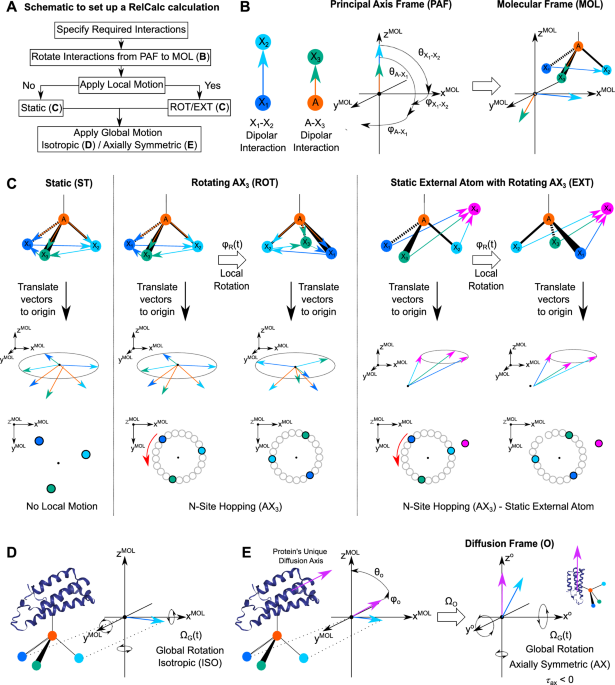
Relaxation phenomena greatly influence magnetic resonance experiments, from setting repetition rates and measurement times through to measuring internal motion of molecules. RelCalc provides a convenient and efficient means for symbolic and numerical evaluation of relaxation rates using Bloch, Wagness and Redfield (BWR) theory. Users supply interactions within a spin system arranged appropriately in the molecular frame. The effects of optional fluctuations around a symmetry axis, and then under either isotropic or anisotropic global tumbling are then computed. Relaxation rates linking pairs Liouvillian basis operators are then returned symbolically, formatted as a sum of weighted reduced spectra density functions. Parameters are then supplied to replace symbolic quantities for values for rapid computation of numerical rates. We demonstrate the utility of the software by exploring relaxation interference (TROSY) effects and 'long-lived states' in X2 and AXn systems, which, for n=1,2, and 3, describe NH, NH2 and CH3 groups in proteins, and small molecules with n=4,6,8,12 and 20 arranged as platonic solids. The implementation is highly efficient with 65,536 relaxation rates required to perform complete Liouvillian simulation of AX3 methyl groups rotating about a symmetric axis in the presence of adjacent static 'external' spins being symbolically calculated in under one minute on a single processor on a 2021 laptop. From this result, a complete set of numerical rates are computed in under one second. RelCalc is implemented in python and is freely available.
The manuscript is here RelCalc: symbolic evaluation of BWR theory relaxation rates in python, applications to TROSY effects in AX $$_n$$ spin systems - Journal of Biomolecular NMR
Any technical inquiries, problems, or suggestions can be addressed to Prof. Andrew Baldwin at andrew.baldwin@chem.ox.ac.uk.
The licence is here
Please complete this form to receive a software download link.